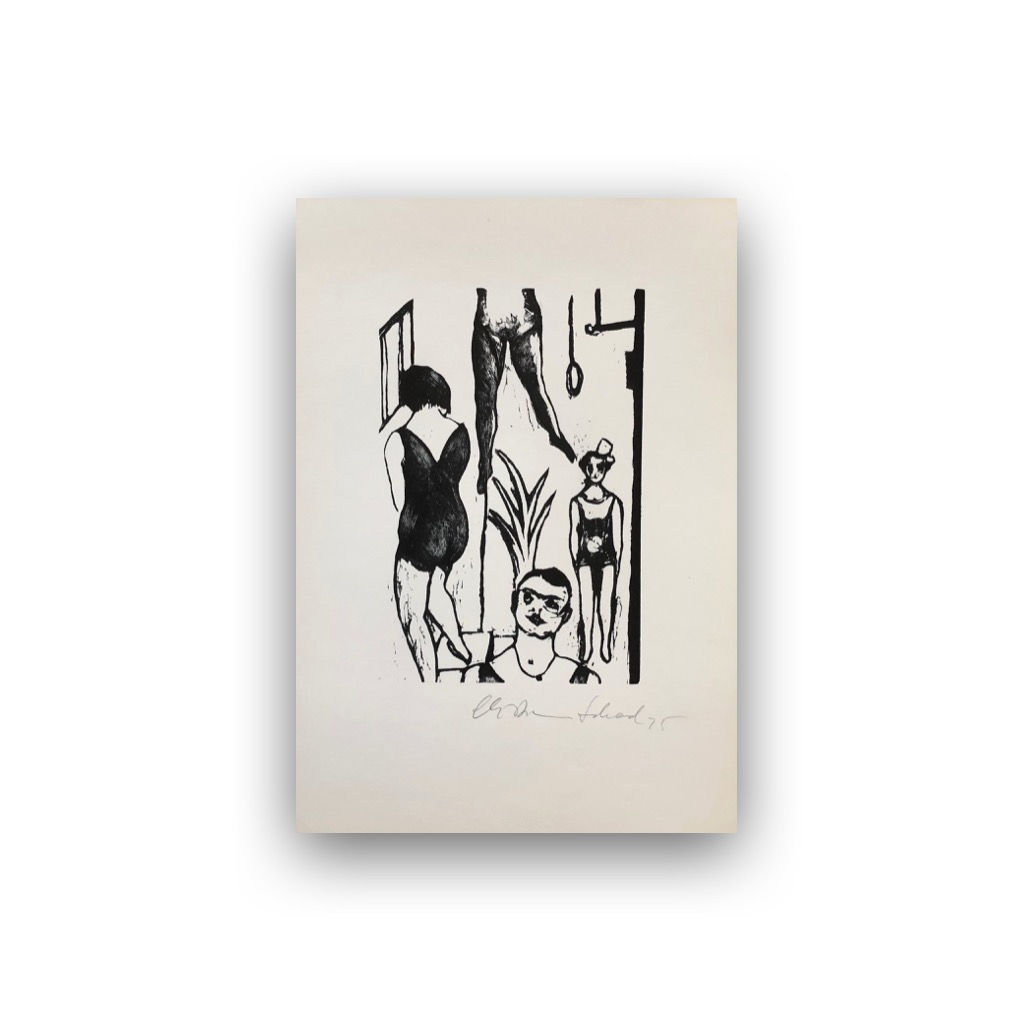

Christian Schad (1894-1982): Varietéprobe 1925
Artist
Christian Schad (1894–1982)
Title
Varietéprobe
Medium
Woodcut
Material
Cardboard
Dimensions
24.5 x 17.5 cm
Editor
Edition Panderma, Basel
Year
1925, published 1960s
Signature
Signed in pencil
Provenance
Edition Panderma, Carl Laszlo, Basel
Galerie von Bartha, Basel
Private Collection, Basel
Condition / Restauration
Mint archival condition
Biography
Christian Schad (Miesbach 1894 – Stuttgart 1982) was a German painter, printmaker and photographer who stands among the defining figures of Dada and Neue Sachlichkeit (New Objectivity). After studying at the Munich academy, the young pacifist crossed into neutral Switzerland in 1915, settling in Zurich and then Geneva, where he moved at the edges of the nascent Dada movement around the Cabaret Voltaire.
It was in Geneva, around 1919, that Schad made his most radical contribution to modern art: the camera-less photogram. By laying scraps of paper, fabric and everyday detritus directly onto light-sensitive paper, he produced abstract shadow-images that Tristan Tzara later christened "Schadographs" — experiments that anticipated the better-known photograms of Man Ray and László Moholy-Nagy by several years. During the 1920s, living in Italy and then Vienna and Berlin, Schad turned to a coolly precise, almost clinical realism, painting the incisive portraits of post-war society for which New Objectivity is celebrated.
This woodcut, Varietéprobe (Variety Rehearsal), belongs to Schad's graphic work of the mid-1920s, capturing the restless theatrical world of the cabaret stage in a bold, angular black-and-white idiom. Long overlooked, Schad's reputation revived from the 1960s onward, and his work now resides in major collections including the Museum of Modern Art in New York, Tate in London and the Neue Nationalgalerie in Berlin, with a museum dedicated to his estate opening in his hometown region at Aschaffenburg. Issued by Carl Laszlo's celebrated Edition Panderma in Basel, this signed sheet is a rare graphic statement from one of the twentieth century's most singular realists.